
Market fear jumps to 24—what history predicts for AI stocks
Understanding the VIX and Market Volatility
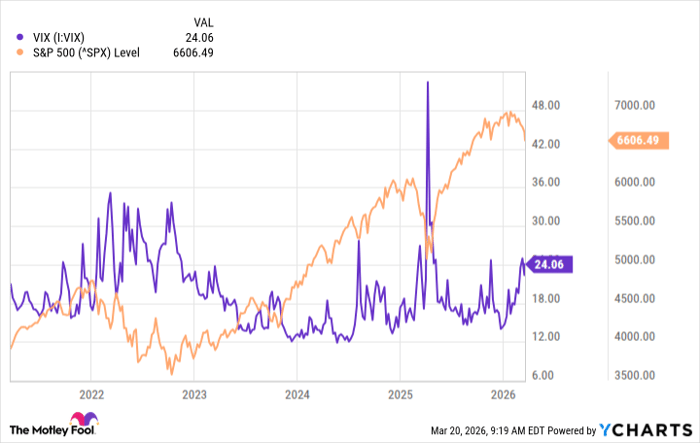
The VIX, often referred to as the “fear” gauge, is a key indicator that reflects investors’ expectations of market volatility. It measures the level of uncertainty in the financial markets over the next 30 days. When the VIX spikes, it typically signals that investors are anticipating increased market turbulence. Recently, the VIX has climbed to 24, which is a significant increase and suggests that fear is on the rise among market participants.
The S&P 500’s Recent Performance
Over the past few weeks, the S&P 500 has experienced a shift from gains to losses, creating a sense of unease among investors. This fluctuation is not unusual, but it highlights the current challenges facing the market. Factors such as uncertainty about AI revenue potential, geopolitical tensions, and concerns over economic conditions have contributed to this instability.

AI Stocks Leading the Way
Artificial intelligence (AI) stocks have been a major driver of market gains in recent years. Companies like Nvidia, Palantir Technologies, and Meta Platforms have seen their stock prices soar as investors recognize the transformative power of AI. These companies are at the forefront of developing technologies that can enhance productivity, reduce costs, and drive innovation across various industries.
Investors have shown a strong interest in AI-related stocks, with many companies investing billions of dollars to support their AI initiatives. For instance, major tech firms have allocated nearly $700 billion for capital spending this year, much of which is directed towards building out AI infrastructure.
However, as these investments unfold, some investors are beginning to question whether the current spending levels are justified. While demand for AI remains high, there is growing concern about the future revenue potential of these companies.
The Role of the VIX in Market Trends
The recent spike in the VIX indicates that investors are becoming more cautious. The VIX, created by the Chicago Board Options Exchange, is based on options trading in the S&P 500. A rising VIX suggests that investors expect increased volatility, while a declining VIX implies a more stable market environment.
Historically, peaks in the VIX have often coincided with declines in the S&P 500. This pattern suggests that AI stocks may face continued pressure in the short term. However, it’s important to note that the S&P 500 has always rebounded after periods of fear and uncertainty. This historical trend offers hope that AI stocks could recover and continue their upward trajectory.
Long-Term Outlook for AI Stocks
Despite the current market fluctuations, the long-term outlook for quality AI stocks remains positive. Savvy investors understand that dips in stock prices can present excellent buying opportunities. By focusing on companies with strong fundamentals and a clear vision for the future, investors can position themselves to benefit from the growth potential of AI.
Should You Invest in the S&P 500 Now?
Before making any investment decisions, it’s essential to consider the broader market context. While the S&P 500 has delivered impressive returns over the years, it may not be the best choice for every investor. Some analysts believe that there are better opportunities available in the market.
For example, the Motley Fool Stock Advisor analyst team has identified what they consider to be the 10 best stocks for investors to buy now. These stocks have the potential to deliver significant returns in the coming years. Historical examples, such as Netflix and Nvidia, demonstrate the power of investing in high-potential companies.
Stock Advisor has consistently outperformed the S&P 500, with an average return of 898% compared to 183% for the benchmark index. This track record underscores the importance of selecting the right investments.
Conclusion
In summary, while the current market environment presents challenges, it also offers opportunities for informed investors. The VIX serves as a valuable indicator of market sentiment, and understanding its implications can help investors make more informed decisions. Whether you choose to invest in AI stocks or explore other opportunities, a long-term perspective and careful analysis are essential for success in the financial markets.