
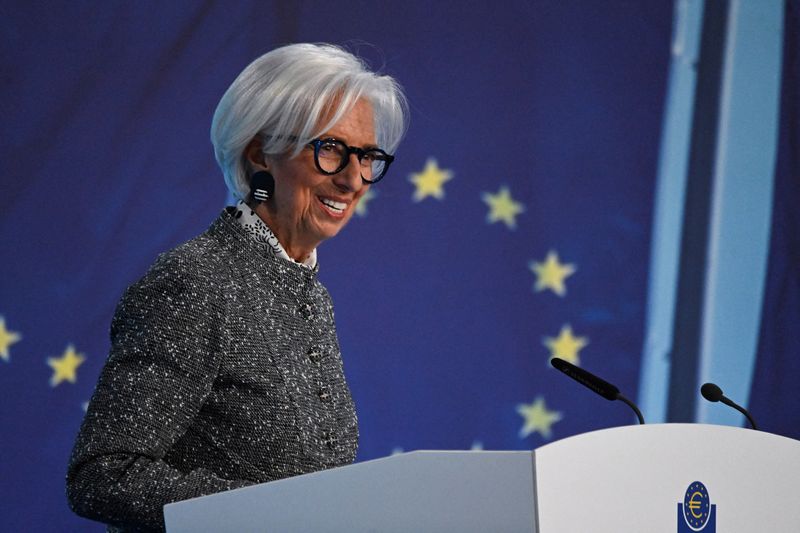
Lagarde Paves Way for Rate Hikes Amid Iran Crisis and Inflation Fears
ECB President Considers Rate Hikes Amid Regional Tensions
European Central Bank (ECB) President Christine Lagarde has indicated that the central bank may consider raising interest rates in the euro zone if the ongoing conflict in the Middle East leads to sustained inflation. This statement comes as the ECB continues to monitor economic conditions and assess potential risks to price stability.
The ECB recently kept interest rates unchanged but issued warnings about a potential surge in prices. Policymakers are now evaluating the conditions that might necessitate an increase in borrowing costs to prevent rapid price growth from becoming entrenched. Lagarde emphasized that the ECB would need to respond decisively if inflation remained significantly above its 2% target for an extended period. However, she also acknowledged that even a smaller overshoot could warrant a “measured” rate adjustment.
“If the shock gives rise to a large though not-too-persistent overshoot of our target, some measured adjustment of policy could be warranted,” Lagarde said during her remarks in Frankfurt. She added that failing to address such an overshoot could pose a communication risk, as the public might struggle to understand a reaction function that does not respond appropriately.
Impact of Regional Conflicts on the Euro Zone Economy
The current situation is compounded by the widening war in Iran, which has begun to affect the euro zone economy. This has led to a decline in German business morale and prompted economists across the region, including those in Portugal and Italy, to warn of slower growth or even a recession.
Olli Rehn, governor of the Bank of Finland, echoed similar sentiments at the same event, suggesting that the ECB should focus on the overall state of the economy rather than just fluctuations in oil prices. “Monetary policy must respond, from the standpoint of medium-term price stability, to the overall macroeconomic environment, not to oil prices alone,” Rehn stated.
Reassessing Scenarios at Every Meeting
Lagarde did not explicitly link her criteria to any specific economic scenarios outlined by the ECB last week. However, her statements align closely with the inflation trajectory in the bank’s “adverse” scenario. In the most optimistic “baseline” case, inflation is expected to average 2.6% this year, rising from around 2% in the previous year. In the adverse scenario, inflation is projected to peak above 4% in the second half of the year but return to target by mid-2027. The severe option suggests inflation could peak above 6% early next year and remain elevated for years.
“If we expect inflation to deviate significantly and persistently from target, the response must be appropriately forceful or persistent,” Lagarde emphasized. “Otherwise, self-reinforcing mechanisms would kick in and the risk of de-anchoring would become acute.”
ECB Chief Economist Philip Lane noted that policymakers will assess which scenario best fits “at every meeting,” keeping April or June as potential dates for a first move. Lagarde reiterated that the bank is prepared to act “at any meeting” and would not allow hesitation to paralyze its decision-making process.
Monitoring Early Warning Signs
The ECB is now focused on identifying early warning signs that the current shock may embed itself in broader inflation dynamics. This includes monitoring spillovers through wages and inflation expectations. “As expected deviations from our inflation target grow larger and more persistent, the case for action becomes stronger,” Lagarde argued.
Lane highlighted companies’ price-hike expectations and wages for new hires as key indicators the ECB will watch. Financial investors now anticipate two to three rate hikes from the ECB this year, as they expect inflation to remain above the central bank’s 2% target for several years. However, Lane pointed out that financial markets have priced in a “price-level jump” in the euro zone due to higher energy prices, rather than a persistent rise above target.
Small, Early Hikes?
Some investors advocate for early but smaller rate increases, citing the ECB’s delayed response during the 2021-2022 inflation surge. The bank faced criticism for acting too late, as it initially believed the spike was transitory and only raised rates when inflation reached around 8%, four times its target.
Lagarde, however, argued that the current situation differs. The energy shock is smaller, particularly concerning natural gas, the labor market is not as tight, there is no post-pandemic pent-up demand, fiscal policies are tighter, and the central bank rate is higher. She also noted that historical evidence suggests the risk of broad pass-through from energy prices is the exception rather than the rule — a point supported by Rehn.
“An energy price spike is always a drag, but its effect on overall inflation depends on the state of the economy which it hits,” Rehn explained.
Nearly two-thirds of economists surveyed by Jendela Magazine expect the ECB to keep interest rates steady this year.