

Oil Crisis Spreads from Gulf to Global Markets
Understanding the Current Oil Market Dynamics
The oil market is currently experiencing unprecedented volatility, driven by a combination of geopolitical tensions and logistical challenges. While global benchmarks like West Texas Intermediate (WTI) and Brent are often cited in mainstream media, the true picture of the market lies in the prices of specific crude grades that are affected by regional disruptions. In the Middle East, traders are paying an eye-watering $160 per barrel for Emirati oil that can bypass the Strait of Hormuz, far exceeding the standard benchmarks. This surge in prices is a clear indicator of the supply squeeze and the potential for further escalation if the situation remains unresolved.
The Impact of Geopolitical Tensions on Oil Prices
The recent postponement of strikes on Iranian energy infrastructure by President Trump has led to a temporary drop in benchmark oil prices. However, this respite may be short-lived as traders remain cautious about the prospects of peace. The key factor here is the need for Iran to agree to an end of hostilities before oil tankers can navigate freely through the strait. Without a swift resolution, the record high prices for specific grades of Middle Eastern crude could soon affect the U.S. and other regions.
Helge Andre Martinsen, an energy analyst at Norwegian investment bank DNB Carnegie, warns that the disruption is so massive that the market could enter full panic mode if the situation is not resolved quickly. A resolution would mean the resumption of oil flow through the strait, but for prices to return to prewar levels, traders also require Persian Gulf producers to reverse output cuts from the early days of the war. Additionally, long-term sanctions relief on Iran and Russia is essential, although the U.S. has only relaxed these for a month.
Price Disparities and Market Distortions
One of the most significant price gaps is between oil that used to flow out of the Gulf and different kinds of crude from farther afield. For instance, prices for a grade of crude known as Dubai had risen well over 150% in 2026, according to commodities data provider OPIS. This is far more than the standard benchmarks cited in the media. In contrast, Brent futures prices have seen a more modest increase of 72% for the year.
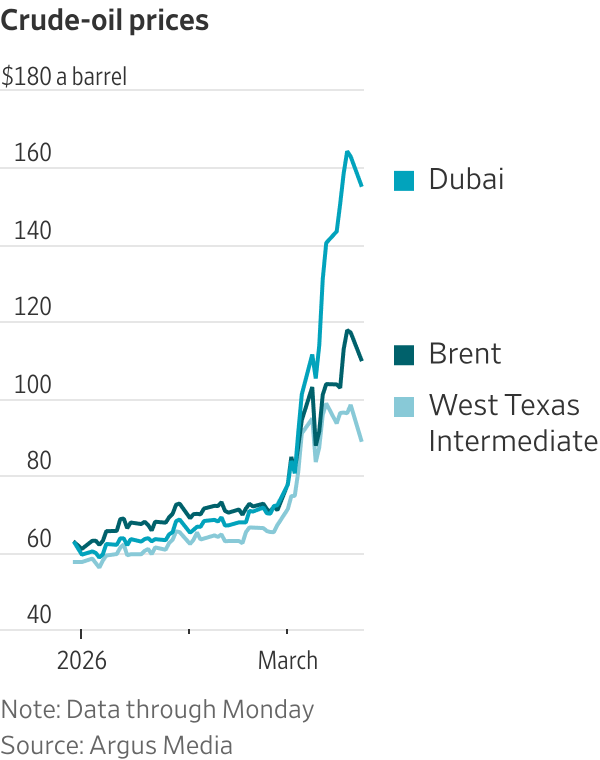

Another notable distortion is the historically wide $12 per barrel premium that Brent crude trades over the WTI American benchmark. This difference can be attributed to WTI’s location, far from where the oil is needed in Asia, as well as higher shipping costs and concerns about U.S. export restrictions. Asian refiners are now seeking sulfur-rich oil to replace the expensive Middle Eastern grades, driving up prices for oil from Norway, Russia, Colombia, and even some U.S. crude.
The Role of Trading Activity and Market Speculation
The chaos in the Gulf has led to significant changes in how prices are determined. For example, the prices for Dubai, the oil, no longer include crude from Dubai, the emirate, due to the closure of the Strait of Hormuz. Instead, the prices reflect deals for oil from Oman and a small amount of crude from Abu Dhabi.
French oil producer TotalEnergies has been particularly active in this market, buying dozens of cargoes. While the exact amount of oil Total has agreed to sell onward is unknown, the company’s massive position suggests a bet that Asian refiners will pay top dollar for scarce supplies.
Broader Implications for International Markets
The scramble for Gulf oil is starting to influence broader international markets. Prices for oil from the Johan Sverdrup field off the coast of Norway have jumped to record premiums over Brent. Other sulfur-heavy crudes, including oil from northern Alaska, have also seen significant price increases.
Amrita Sen, founder of consulting firm Energy Aspects, notes that Asia is fighting for every barrel available in the world. She predicts that Brent prices will eventually catch up with the Middle Eastern crudes changing hands at over $150 a barrel if the Strait of Hormuz remains closed. Meanwhile, WTI, far from the action and lacking sulfur, can continue trading at huge discounts.
The Global Supply Shortfall
Before the war, almost a fifth of global oil supplies passed through the Strait of Hormuz each day, totaling around 15 million barrels of crude and five million barrels of refined fuels. Workarounds have allowed some oil to flow through alternative routes, such as a Saudi pipeline to the Red Sea. However, as of Monday, the closure had reduced daily oil supplies by 16 million barrels, according to JPMorgan Chase analysts. This shortfall could shrink next month with more oil flowing through the pipe and releases from strategic stockpiles in the U.S. and its allies. Nevertheless, the world economy would still face a daily shortage of 10 million barrels of oil.