

Middle East Tensions Push Nasdaq into Correction

Investors are showing signs of losing confidence in a swift resolution to the ongoing conflict in Iran. Major U.S. stock indices experienced a downturn on Thursday, while oil prices climbed back above $100 per barrel, reflecting the lack of progress in ending the war.
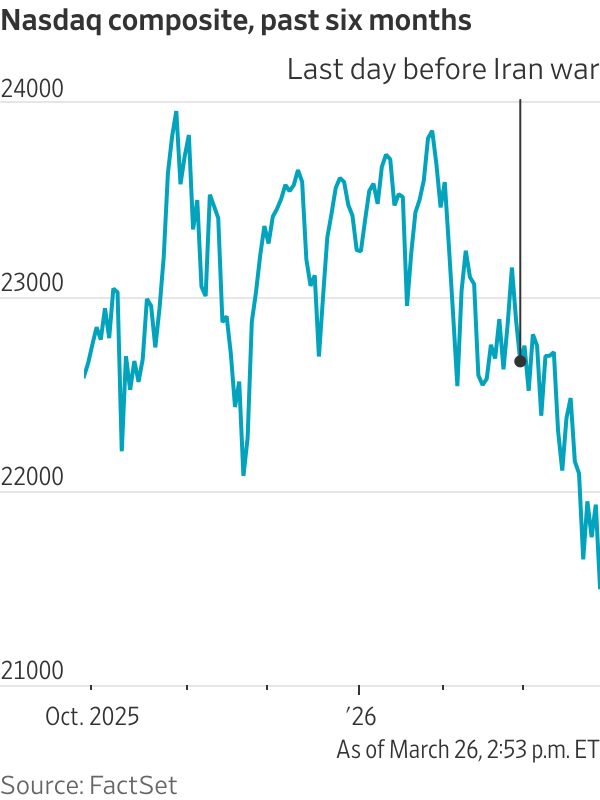
As the conflict continues, financial markets are feeling the strain: The Dow industrials are on track for their most significant one-month percentage drop since 2022, and the Nasdaq composite has entered correction territory, having fallen more than 10% from its peak. The Dow fell by 469 points, or 1%, while the S&P 500 dropped 1.7% and the Nasdaq slid 2.4%. Both the S&P and Nasdaq recorded their largest single-day declines since the war began, closing at their lowest levels since September.
Earlier in the week, stocks saw some gains as investors reacted positively to a social media post from the president stating that the U.S. military would delay strikes on Iranian power plants. However, this optimism was short-lived, as market sentiment shifted on Thursday.
“It just has to do with the growing realization that here we are on Thursday and there’s a lot of uncertainty about what is happening in the Gulf,” said Thomas Martin, senior portfolio manager at Globalt Investments. “The markets are trying to figure out, ‘Is there a deal in there somewhere?’”

The Dow industrials remained relatively stable when President Trump addressed a morning cabinet meeting. He stated that he expected gas and oil prices to have risen significantly due to the conflict in Iran and added that energy prices “have not gone up as much as I thought.” Trump also mentioned that he anticipated further price increases, saying, “Maybe it’ll go up a little bit more. It’s all going to come back down.”
During the meeting, Treasury Secretary Scott Bessent emphasized that the American public is prepared to endure “short-term volatility” in order to achieve five decades of security after the Iranian regime is defeated. As the meeting progressed, stock declines accelerated. Trump had set a Friday deadline for Iran to reopen the Strait of Hormuz, a critical route for oil exports.
After the markets closed on Thursday, Trump announced on social media that he was postponing strikes on Iranian energy facilities for an additional 10 days. However, equities had already been declining for weeks due to the ongoing uncertainty surrounding the war, which has particularly affected consumer staples and industrial companies.
Analysts warn that the longer the conflict persists, the greater its impact on energy prices and the threat it poses to global markets. In a quarterly report, the Organization for Economic Cooperation and Development highlighted that the global economy could face a significant setback if energy prices remain elevated for an extended period.
“Time is not on our side,” said Ed Yardeni, president of Yardeni Research. “Every day that this war continues increases the odds of a global recession.”
The S&P 500 and the Nasdaq were both affected by the declining shares of Meta Platforms. The owner of Instagram and Facebook saw its stock fall nearly 8% following two consecutive rulings that held the company responsible for the harmful effects of its products on young people. This decline caused the company to fall behind Tesla in terms of market capitalization, becoming the eighth-largest U.S. company by market cap for the first time since September 2023. Meta lost $119 billion in value on Thursday.
Treasury yields increased on Thursday, continuing to align with rising oil prices and concerns over inflation. Benchmark 10-year yields climbed to 4.415% from 4.326% on Wednesday. A weak auction for 7-year U.S. government debt added to worries in the bond market.
Precious metals also continued to decline from near-record highs, with gold futures experiencing a 3.8% drop on Thursday, reaching their second-lowest close of the year. The end-of-day price of $4,375.50 per troy ounce puts gold on pace for a 16% decline this month. Silver fell 6.5% to its lowest level since December.
Markets are “moving pretty heavily on what President Trump says, and that’s kind of just the norm,” said Paul Stanley, chief investment officer at Granite Bay Wealth Management. “The big news is still just Iran and whether there’s going to be a deal made.”